|
New Energy Research Laboratory Device
and Process Testing Update
Published in IE Volume 5, Issue #26
Conducted by Jed Rothwell, Ed Wall and
Gene Mallove
July, 1999
Plasma Electrolysis Experiments
Tadahiko Mizuno (Hokkaido National University)
reports continued success with plasma discharge electrolysis cold
fusion experiments, which were first reported at ICCF-7 and here.
[Ohmori, T., "Strong Excess Energy Evolution, New Element Production
and Electromagnetic Wave and/or Neutron Emission in Light Water
Electrolysis with a Tungsten Cathode," Infinite Energy
No. 20]
Mizuno, Ohmori, and Akimoto recently co-ed a paper
titled "Production of Heat, Light and Neutrons During Electrolysis
in Liquid." They report output energy exceeds input by 30 to
100% or more, as well as evidence for neutrons and transmutations
with cathodes made of platinum and tungsten. We will translate this
paper and publish it in an upcoming issue.
The calorimetry is improved. Input power, the most
problematic parameter, is measured independently with a power meter
(Yokogawa WT130), and by collecting the data on computer with a
fast data logger (Advantest R7326-B). The computer log and the power
meter agree within 0.99±0.07 on average. Cells can now be
run with isoperibolic calorimetry as was done previously, or with
flow calorimetry. Effluent water vapor is condensed and weighed
to the nearest milligram. Runs have been extended to as long as
5000 seconds (83 minutes) by condensing the water and returning
it to the cell. Excess heat is observed during the entire period.
An analysis of a replication in Canada indicated that the excess
heat might be an artifact of the calorimetry, but if this were the
case, Mizuno's heat would fade out in for five or ten minutes.
The success rate has risen to roughly seven out of
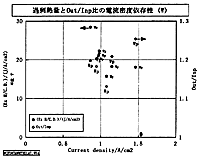
ten experiments. Results from an extensive set of runs lasting 1000
seconds each were graphed to identify control parameters. For example,
excess heat with tungsten is only observed when current density
is between 0.7 and 1.6 amperes per cm2 (see Figure 1). Excess heat
begins rising exponentially above 75° to 80°.
Mizuno's Data
Click on image for enlargement.
|
In 1998, we were not able to replicate satisfactorily
the excess heat in this experiment, and neither was Scott Little
of EarthTech International, or Jean Paul Biberian at the French
Atomic Energy Commission. Clearly, the experiment is more difficult
than it first appears, or the excess heat is an artifact of Ohmori
and Mizuno’s instruments. Mizuno is now collaborating and assisting
both us (NERL) and Little, by supplying assembled, prepared tungsten cathodes, and by advising us on how to do the experiment.
Unfortunately, the cathodes supplied by Mizuno are
fragile. The lead wire attached to the rectangular foil cathode
snaps off easily. All of Little’s samples broke before he got
a chance to test them. The samples he made by himself did not produce
excess heat. Little is using a different type of container and different
cell geometry than Mizuno, and the power profile he observes looks
different from the one seen in Mizuno’s graphs.
In early July, Jed Rothwell will visit Mizuno’s
laboratory for hands-on training in this experiment. He will make
a video of the test procedures and acquire cathode materials, a
quartz glass cell, samples of the potassium reagent, and other materials
in order to perform a close replication at NERL.
Mizuno reports that a successful replication of the
experiment has been performed by Kansai Research, Inc. (KRI), a
subsidiary of Osaka Gas.
Scientists at KRI used cathode materials supplied by Mizuno, placed
in a 4-liter dewar vessel with 0.2 molar K2CO3 electrolyte. The
vessel has a thick transparent plastic top, which allows them to
look down into the cell to observe and control the glow discharge.
They pre-heated the water to 60°C and then ran the plasma electrolysis
discharge until the temperature reached 86 °C. In one sample
run, total input was 226 kJ, and cell enthalpy was 329 kJ: 3089
grams water * 4.184 * (86.1°C - 60.6 °C). Heat release from
the Dewar was 11.8 kJ and the enthalpy of the effluent gas was 7.6
kJ, so the total average input to output ratio was 1.54. The output/input
ratio has varied from as low as 1.06, to 2.81 maximum.
Catalytic Fusion
The catalytic fusion process of Dr. Les Case
got a significant boost in early June. Dr. Michael McKubre of SRI
International reported on a series of convincing experiments. These
appear to confirm Case’s conclusion that helium-4 can be produced
by the catalytic action of palladium-doped carbon in heated vessels
containing pressurized (several atmospheres) heavy hydrogen (D2)
gas. McKubre spoke on June 3, 1999 at the Society for Scientific
Exploration’s 18th Annual Meeting, which was held at the University
of New Mexico in Albuquerque.
McKubre reiterated the SRI results first divulged at the APS meeting
in March by Russ George of Saturna Technologies, Inc. He described
the now famous experiment that produced a steady heat output and
monotonic increase of helium reaching about 11 ppm from day 5 to
30 of the run (about twice the laboratory and standard atmospheric
background of 5.2 ppm).
This and similar experiments at SRI employed sealed
50 cm3 metal cells connected to a sensitive mass spectrometer, which
is well able to separate out the D2 peak from the 4He peak. A control
cell containing H2 gas produced absolutely no excess heat or helium.
McKubre suggested that excess heat output of about 0.25 to 0.5 watt
was possible evidence for the fusion reaction of two deuterium nuclei
to helium-4 with an energy release of about 23.8 MeV. The most important
news is that SRI has run about a dozen Case cells, with a success
rate of about one in two or three. It is not especially easy to
do this work–as we at NERL have found in some of our initial
experiments. The catalyst has to be kept very clean. (There may
also be some special thermal gradient conditions that need to be
met.)
Cold fusion skeptic Richard Murray, who attended
the SSE meeting, had this reaction initially about the McKubre report:
"The fact that the cells can not always be made to work increases
the credibility of the report in my eyes, as I would expect a simple
artifact to occur every time, since the output helium rises in a
simple, untroubled line. My meager wits are unable to imagine any
applicable artifact. Therefore, I expect this breakthrough success
to continue at SRI, and to be speedily replicated by other labs.
In addition, since in physics, the basic rule is that what is not
prohibited is mandatory, then we must give much greater credence
to the vast body of reports of the many varieties of cold fusion
in the last ten years. The seedling has not expired and deserves
copious watering. Without being specific, McKubre said that theoretical
progress was being made."
True to the "hint and run" behavior of skeptics,
Murray later backed-away from his positive assessment and came up
with an easily dismissed objection: that covertly bound helium might
have been emitted by the catalyst itself! There is no credible evidence
that this could be occurring, especially in view of the fact that
no helium was found to build up in the ordinary hydrogen or deuterium
control test with the same batch of catalyst. It is quite clear
now that this catalytic fusion direction is among the most promising
of the low energy nuclear reaction processes.
Calorimeter Development
NERL’s flow calorimeter went through a redesign
when the previous design, which employed pulse width modulation,
failed to meet stringent inlet water temperature requirements. A
better method using amplitude modulation resulted in vastly improved
regulation, which will enable better calorimeter sensitivity. Further
testing and some tuning will soon enable us to perform this versatile
form of calorimetry.

|