 |
Sir Arthur C. Clarke Challenges the
Scientific Community with Provacative Essay in Science
(Originally Published July, 1998
In Infinite Energy Magazine Issue #20)
by Eugene F. Mallove
"Cold Fusion scientists need not apply." Yes,
the pages of Science Magazine are closed to them. Science,
the magazine of the American Association for the Advancement of
Science, has a standing policy (unwritten but demonstrated in
practice many times) of rejecting any submitted scientific articles
on cold fusion that provide supportive evidence. In June 1990, Science
published a virtually libelous article by journalist Gary Taubes
against the research group at Texas A&M University--alleging the
likelihood that tritium was fraudulently introduced into electrochemical
cold fusion cells by associates of Distinguished Professor of Chemistry
John O'M. Bockris.
|
|
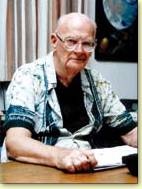
Sir Arthur C. Clarke
|
These accusations were baseless and were disproved,
but they were published and never withdrawn by Science—
or by Taubes.
This negativity did not stop Sir Arthur C. Clarke,
who since 1992 has been a serious student of the cold fusion controversy.
He penetrated the Science barrier. Clarke is so revered by
most scientists, that Science dared not prevent him from
stating his opinion of cold fusion when it invited him to participate
in its "Science and Society" series of essays.
The lead essay in the June 5, 1998 issue of Science
is Clarke's eloquent, "Presidents, Experts, and Asteroids." In this
wide-ranging composition, Clarke makes his position very clear.
He politely calls the treatment of cold fusion "perhaps one of the
greatest scandals in the history of science." By implication, he
criticizes the well-known negative position of Science magazine
on this topic. It will be interesting to see whether even the mighty
Sir Arthur can cause a re-assessment of cold fusion at Science.
Clarke opens his essay with: "For more than a century
science and its occasionally ugly sister technology have been the
chief driving forces shaping our world. They decide the kinds of
futures that are possible. Human wisdom must decide which are desirable.
It is truly appalling, therefore, that so few of our politicians
have any scientific or engineering background." (Amen!)
| ...perhaps one of the greatest scandals
in the history of science, the cold fusion caper.
|
After musing on various themes--from the failings
of experts ("Lord Kelvin's declaration that x-rays must be a hoax,
and Ernest Rutherford's even more famous dismissal of atomic energy
as 'moonshine.'") to what can be done about the threat of asteroid
impacts, Clarke ascends to the unthinkable--support for cold
fusion:
"Even more controversial than the threat of
asteroid impacts is what I would call perhaps one of the greatest
scandals in the history of science, the cold fusion caper. Like
almost everyone else, I was surprised when Pons and Fleischmann
announced that they had achieved fusion in the laboratory; and surprise
changed to disappointment when I learned that most of those who
had rushed to confirm these results were unable to replicate them.
Wondering first how two world-class scientists could have fooled
themselves, I then forgot the whole matter for a year or so, until
more and more reports surfaced, from many countries, of anomalous
energy production in various devices (some of them apparently having
nothing to do with fusion). Agreeing with Carl Sagan's principle
that 'extraordinary claims require extraordinary proofs' (spoken
in connection with UFOs and alien visitors), I remained interested,
but skeptical."
"Now I have little doubt that anomalous energy
is being produced by several devices, some of which are on the market
with a money back guarantee, while others are covered by patents.
The literature on the subject is now enormous, and my confidence
that 'new energy' is real slowly climbed to the 90th percentile
and has now reached the 99% level. A Fellow of the Royal Society,
also originally a skeptic, writes: 'There is now strong evidence
for nuclear reactions in condensed matter at low temperature.' The
problem, he adds, is that 'there is no theoretical basis for these
claims, or rather there are too many conflicting theories.'"
"Yet recall that the steam engine had been
around for quite a while before Carnot explained exactly how it
worked. The challenge now is to see which of the various competing
devices is most reliable. My guess is that large scale industrial
application will begin around the turn of the century--at which
point one can imagine the end of the fossil-fuel-nuclear age, making
concerns about global warming irrelevant, as oil-and-coal-burning
systems are phased out..."
"Finally, another of my dubious predictions:
Pons and Fleischmann will be the only scientists ever to win both
the Nobel and the Ig Noble Prizes."
| SIR ARTHUR CLARKE, a graduate
of King's College, London, is the of numerous works of science
and science-fiction, including his well-known collaboration
with Stanley Kubrick on the movie 2001: A Space Odyssey.
He is presently Chancellor of the International Space University
and Chancellor of the University of Moratuwa, Sri Lanka, where
he has lived for 30 years. He is the acknowledged originator
of the concept of geosynchronous communication satellites that
have made our world One--almost. |
Related Articles
2001:
The Coming Age of Hydrogen Power, by A.C. Clarke
Arthur C. Clarke: The Man Who "Predicted"
Cold Fusion and Modern Alchemy, by Eugene Mallove

|




































