|
|
 |
   |
 |
|
          |
|
 |
|
 |
|
 |
|
 |
|
 |
|
 |
|
 
   |
|
 |
|
     |
|

 |
||
 
Book Review
ISBN 0-9745261-0-X, $19.95 Paperback, 307
pp.
Poseidia Press, 2003
Review by Eugene F. Mallove
From Infinite Energy #55,
May/June 2004
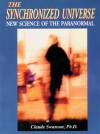
The Synchronized Universe is a courageous, audacious, and very sophisticated catalog of seemingly interrelated phenomena—such as psychokinesis, ESP, remote viewing, etc.—which, if they are real, transcend currently accepted models of physics; they are thus, for now, called “paranormal.” It is an almost unique work of synthesis and skilled documentation, coming as it does from a physicist who was rigorously trained at MIT and Princeton in mainstream physics.
I must confess that I view Dr. Swanson as a kindred spirit, though I did not know him personally when we were in the same entering MIT class, the one graduating in 1969; he majored in physics, and I in aero/astro engineering. But Dr. Swanson, whose heretical views about the process of science happened—independently—to converge with my own, formerly would have been highly skeptical of the cornucopia of paranormal experiments and observations that he so ably weaves together. Though I may not accept all of his conclusions about many of these (to me) unfamiliar phenomena and the beginnings of the cross-phenomena theoretical understanding that he proposes, I give this significant work my highest recommendation. It is a landmark book that deserves wide recognition.
After MIT, Claude Swanson went to Princeton University, where he obtained his Ph.D., also in physics. For many years he worked in R&D on a host of conventional research projects (and he still does), never imagining that one day he would find himself pursuing deep scientific heresy, in fact many heresies. Some of these are far more threatening to the present scientific enterprise than “mere” new energy sources, such as LENR and vacuum energy.
What is most refreshing about the approach he takes in this book are the very great efforts he has made to verify first hand some of the so-called paranormal phenomena he and others have explored. For example—horror of horrors, literally—he has taken what turned out to be photographs of anomalous phenomena at an alleged “haunted house”! Furthermore, while it has not been possible for him to have had first hand experience with the many classes of phenomena that are dubbed “paranormal,” I give the author enormous credit for having dug up and referenced a huge body of original material, so that interested readers can explore these areas for themselves. The aspect of such phenomena that had caught my attention earlier are the seemingly bullet-proof psychokinetic experiments, which have been conducted for over two decades by Prof. Robert Jahn (formerly Princeton’s Dean of Engineering) and his colleagues at the Princeton Engineering Anomalies Research (PEAR) group. The author covers these too, of course.
Swanson’s experience as a heretic apparently began when he was forced to conclude that some “remote viewing” experiments, which had been reported to him, appeared to him to be very sound. He recalls, “That was the day I came face to face with information that I could not dismiss and could not explain.” The troubling thought began to enter his mind: “But what if modern science still has a few things to learn? What if present-day physics is leaving out a few important truths about the universe as well.” So well understated!
His answer, after years of exploration: “This seems to be the case. There are many phenomena which have been proven in the laboratory [yes, he also lists among these cold fusion], yet which mainstream physics steadfastly refuses to admit or recognize. Why? Because if it did, it would turn the present world view of physics upside down. But there is good news too. It would bring a golden age of new discoveries and new technology, undreamed of today. And, it would bring modern science and modern religion much closer to healing the ancient rift which separates them.”
Swanson’s microscope is sharply focused on some of the preposterous affectations of modern physics. About the current view of physics that up to 95% of the “matter” of the universe is supposedly “dark” and unknown, Swanson quotes Princeton’s Prof. James Peebles, “It is an embarrassment that the dominant forms of matter in the universe are hypothetical. . .” He approvingly quotes Peebles’ antagonist, astronomer Halton Arp: “The tradition of ‘peer review’ of articles published by professional journals has degenerated into almost total censorship. Originally, a reviewer could help an author improve his article by pointing out errors in calculation, references, clarity, etc., but scientists, in their fervid attachment to their own theories, have now mostly used their selection as a referee to reject publication of any result that would be unfavorable to their own personal commitment. . .The result is that real investigative science is now mostly an underground activity.” (Arp, 2000)
This work is quite impressive, even though I am far from confident that Dr. Swanson’s outline of a theory to encompass the phenomena he catalogs is going in the right direction. But, no matter—pun intended—if even a small fraction of these phenomena are valid, the answer to how they occur will certainly have to be in the massless, i.e. “non-inertial matter” or “no matter” realm.
This is a marvelous book that I am proud to recommend to anyone. It is apparently only the first volume of a much larger series of works on anomalous phenomena in general that the author has planned, and which may require deep alterations in physics. We should wish him well and await his further insights. He has just begun a new lifework.
Copyright © 2014-2015. All rights reserved. E-mail: staff@infinite-energy.com
|
||
 |
|
|